
AI Search & GEO
Your buyers now ask AI before they ask around — are you in the answer?
Word of mouth used to be the first step in buying. Now it’s a question to ChatGPT. Here’s why being named in the answer decides who wins t...

For two decades, the shape of a Google search was fixed in everyone’s mind: a box, a button, and ten blue links. Win one of those links and you won the click. That model built entire industries — and entire lead pipelines for B2B firms. It’s now coming apart. Google AI Overviews answer questions directly […]
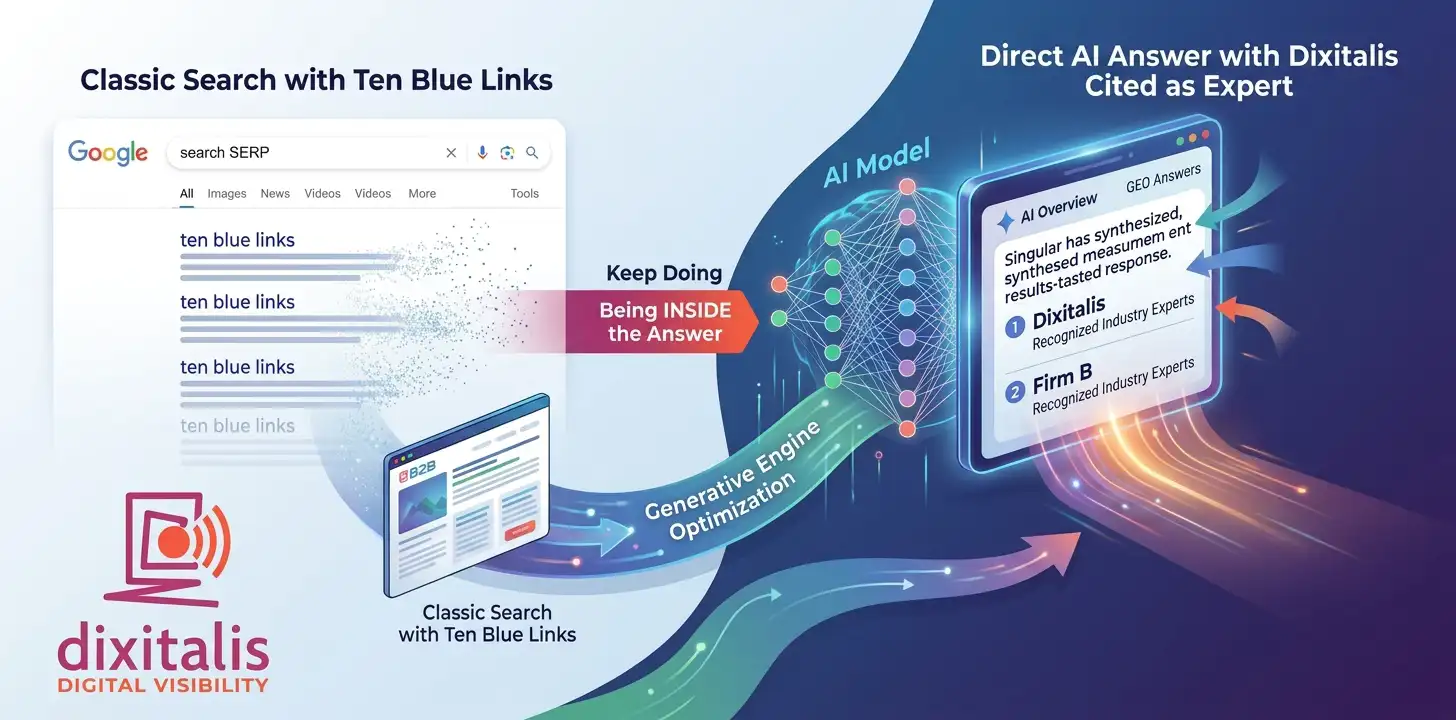
For two decades, the shape of a Google search was fixed in everyone’s mind: a box, a button, and ten blue links. Win one of those links and you won the click. That model built entire industries — and entire lead pipelines for B2B firms.
It’s now coming apart. Google AI Overviews answer questions directly at the top of the page. ChatGPT and Perplexity skip the page of links entirely. Increasingly, the search ends with an answer, not a list — and the user never clicks through to anyone. If your lead generation quietly depends on those clicks, this shift is already affecting you, whether you’ve noticed it in the numbers yet or not.
Three things are happening at once:
Search is moving from “here are ten places to look” to “here’s the answer” — and your job is to be inside the answer.
For a B2B firm, a single new client can be worth a great deal. You were never chasing thousands of clicks — you needed a handful of the right ones. That makes the new world less scary than it sounds: you don’t need to dominate AI answers everywhere, you need to be named for the specific questions your ideal clients ask.
It also raises the stakes on the questions that matter. “Best [your service] firm in [your city]” or “[your industry] consultant for [specific need]” are low-volume, high-value queries. Being the firm AI names for those is worth more than ranking tenth for a thousand generic ones.
You don’t need to win every answer. You need to win the few answers your next client is actually asking.
We’ll show you where your traffic and visibility stand across both classic search and AI answers.
Here’s the part that should lower your blood pressure: the fundamentals haven’t been thrown out. AI answers are built from the same web that search has always indexed. A fast, well-structured, trustworthy site is still the foundation. What changes is the emphasis on top of it.
Strong technical SEO, genuinely useful content, a fast site, and consistent business information. These now feed two channels — classic search and AI answers — instead of one.
Write clear, self-contained answers to the real questions buyers ask. Add structured data so machines read you correctly. Earn credible third-party mentions. And track whether AI tools actually name you — because you can’t improve what you never check. That whole discipline has a name: Generative Engine Optimization.
The end of ten blue links isn’t the end of being found — it’s a change in where being found happens. The firms that adapt early, while their competitors are still arguing about whether AI search is real, will be the ones quietly named when buyers go looking.
Want to see whether AI currently names your firm for the questions that matter? Start with a free SEO check.