AI Search & GEO
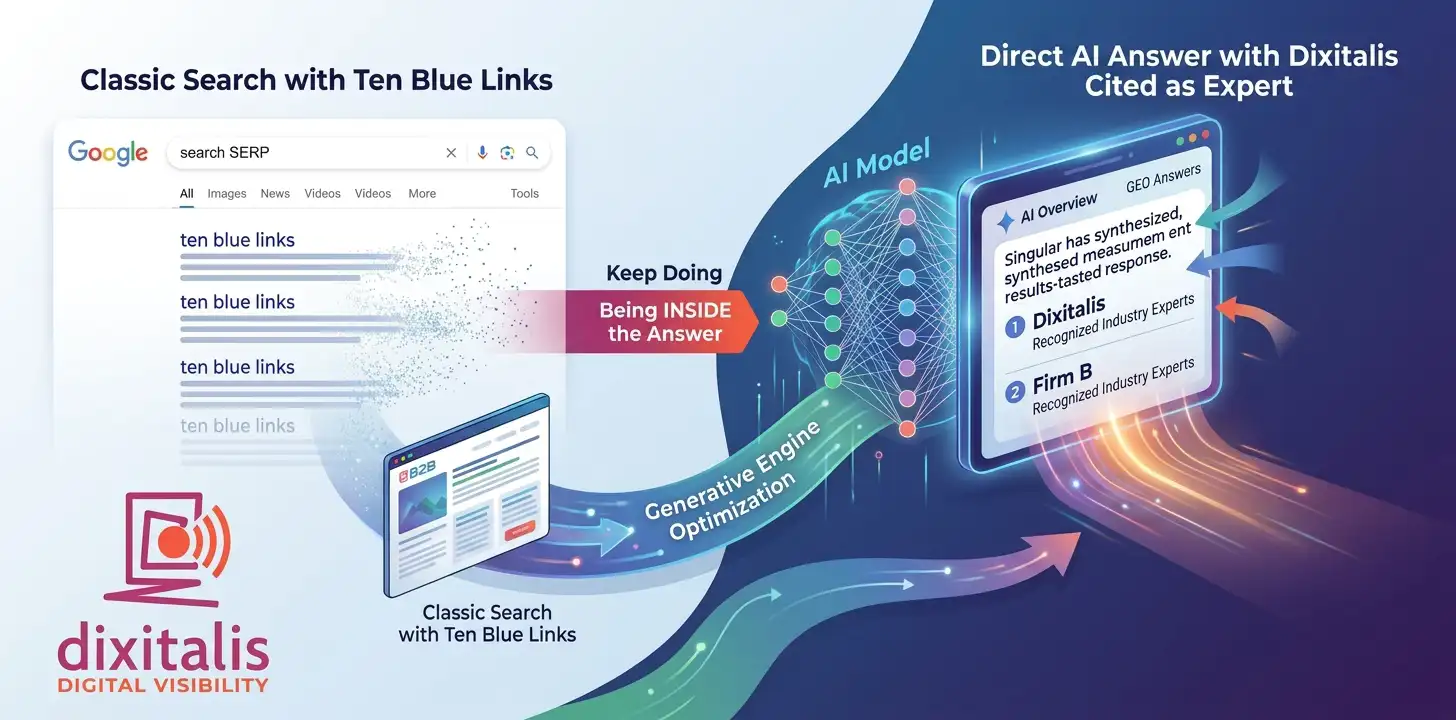
The end of ten blue links: how AI search is reshaping B2B lead generation
For two decades, the shape of a Google search was fixed in everyone’s mind: a box, a button, and ten blue links. Win one of those links and you ...

An AI doesn’t recommend the best firm — it recommends the firm it can describe with confidence. Here’s how to make sure that’s yours. Ask ChatGPT to recommend an accounting firm, a consultancy, or a construction company in your city, and watch what happens. It will name a few. Not at random — it names […]

An AI doesn’t recommend the best firm — it recommends the firm it can describe with confidence. Here’s how to make sure that’s yours.
Ask ChatGPT to recommend an accounting firm, a consultancy, or a construction company in your city, and watch what happens. It will name a few. Not at random — it names the businesses it understands: the ones whose identity, services, and credibility are spelled out clearly enough that a machine can repeat them with confidence.
That’s the uncomfortable truth of AI search. It isn’t always the best firm that gets recommended. It’s the firm the model can describe without guessing. If an AI can’t tell what you do, who you serve, and why you’re trustworthy, it quietly leaves you out — and recommends the competitor it can describe.
The good news: “being understandable to a machine” isn’t a dark art. It comes down to structure. Here’s the structure that gets your firm named.
AI systems build a profile of your business from signals scattered across the web. When those signals conflict — a different business name here, an old address there, services described three different ways — the model loses confidence and falls back on a competitor it’s surer about.
This is unglamorous housekeeping, and it’s the single highest-leverage thing most firms ignore.
An AI recommends what it can describe confidently. Consistency is how you give it that confidence.
Models love content they can lift cleanly. A paragraph that fully answers one question — “How much does a website audit cost?” or “What’s the difference between SEO and GEO?” — in a few sentences, without needing the rest of the page for context, is easy to quote. Copy that rambles, buries the answer, or assumes the reader already knows the setup is hard to cite.
Write like you’re answering a client’s exact question, then stop. One question, one tight answer, then the next.
Use headings that mirror how people actually ask: “Do I need GEO if my SEO is already good?” works far better than a vague “Our Approach.” The heading tells the model what the passage beneath it answers.
Behind the scenes, structured data — schema markup — labels your content so machines don’t have to guess. Organization schema confirms who you are. Service schema lists what you offer. FAQ schema packages your answers in a format AI tools readily reuse. None of it shows on the page; all of it helps a model parse you correctly.
Add to that visible authorship — real names, real credentials, real experience — and you give both search engines and AI the evidence they need to treat you as a credible source rather than an anonymous brochure.
Schema doesn’t make you rank by magic. It removes ambiguity — and ambiguity is exactly what makes a model skip you.
We’ll check your structure, schema, and consistency — and show you exactly where AI loses the thread.
Your own website says you’re great. So does everyone’s. What moves the needle is corroboration: industry directories, guest articles, reviews, and mentions that describe your firm the same way you do. When independent sources echo your identity, the model’s confidence climbs — and confidence is what turns into a recommendation.
Getting named by AI isn’t about gaming an algorithm. It’s about removing every reason for a machine to be unsure about you: consistent identity, clear answers, clean structure, and credible corroboration. Do that, and you stop being the firm the AI forgets.
Not sure how clearly your firm reads to a machine right now? A free SEO check will show you where the ambiguity is.